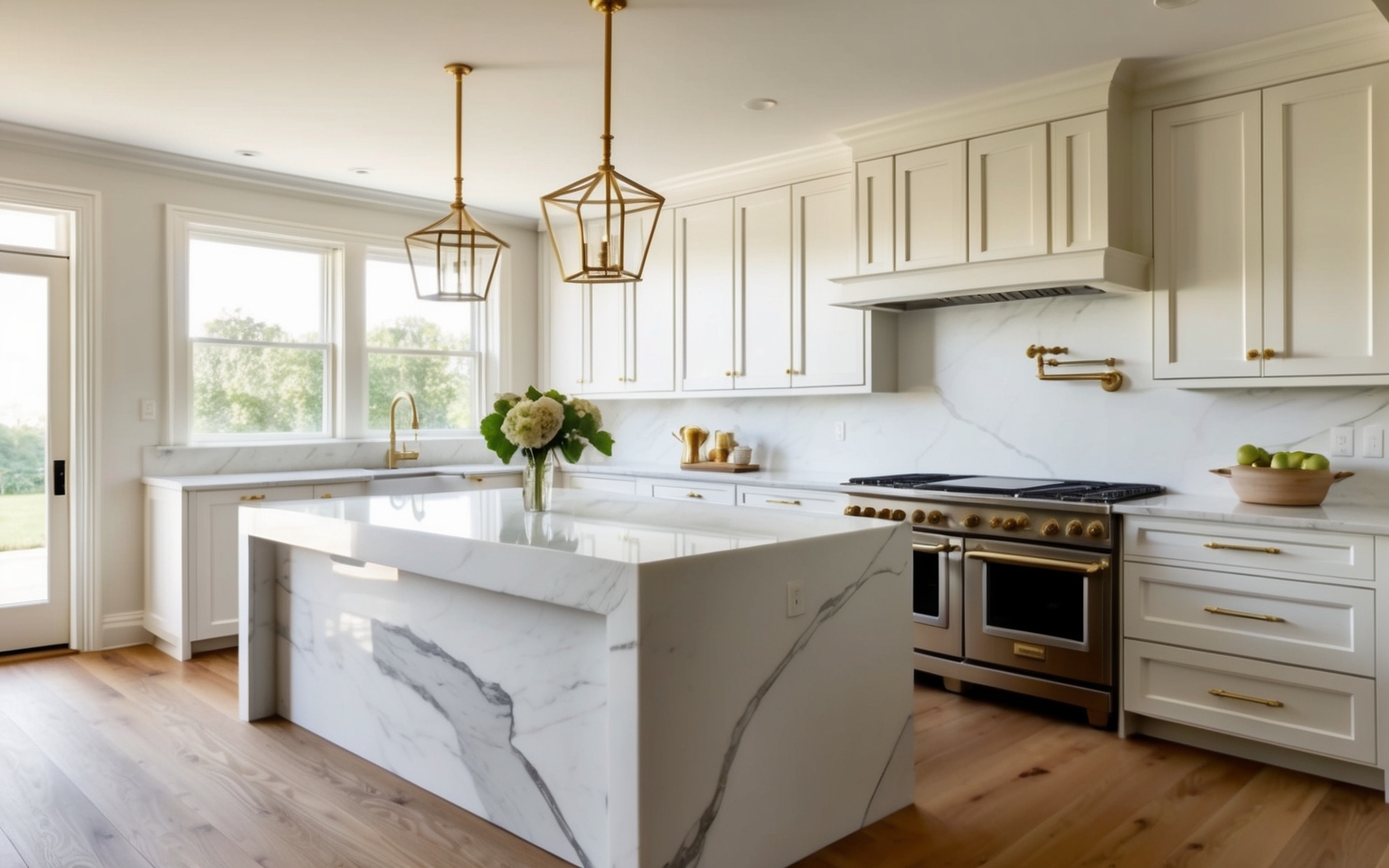
2026 is the year Fort Lauderdale renovations turn warmer and quieter. Cool grays are out, warm whites and creams are in. Brass and aged nickel replace chrome. Real marble slabs are everywhere again. Indoor-outdoor living is non-negotiable on any new project. And homeowners are spending less on the visible "wow" finishes and more on the invisible systems — lighting, climate, and acoustics.
If you've been planning a renovation for a year and you're finally pulling the trigger in 2026, here's the good news: the trends actually got better. The cool, gray-everything aesthetic that defined 2018–2023 has finally yielded to something warmer, more livable, and frankly, more timeless.
We've completed 27 renovations across Broward and Palm Beach so far this year, and the same handful of themes keep coming up in every design meeting. Here are the eight that matter most.
1. Warm Whites Replace Cool Grays
The biggest single shift in 2026 is the death of cool gray. Sherwin-Williams Repose Gray and Benjamin Moore Stonington Gray — the two most-used wall colors of the last decade — are quietly being painted over in favor of warmer creams: Benjamin Moore White Dove, Swiss Coffee, and Simply White; Sherwin-Williams Alabaster and Greek Villa. The same warmth is showing up in kitchen cabinetry (creamy whites and bone whites rather than crisp pure whites) and bathroom tile (limestone tones over cool marble).
2. Brass and Aged Nickel Are Everywhere
Polished chrome has been declining for five years, but 2026 is the year it's officially over in luxury renovations. Replacing it: unlacquered brass (which patinas over time), aged nickel, and champagne bronze. We're seeing brass faucets, brass cabinet hardware, brass light fixtures, and brass shower trim all in the same project — and it works because the warmer metals tie into the warmer wall colors.
Lacquered brass scratches easily and shows fingerprints. If you want the look without the maintenance, ask for satin brass or aged brass with a protective finish. Save the unlacquered solid brass for pieces that don't get touched often — light fixtures, towel bars, cabinet pulls.
3. Natural Stone Comes Back (Real Marble, Not Quartz)
Quartz had a great run. It's still a fantastic, durable, low-maintenance material — but in 2026, homeowners are willing to commit to real marble again. Calacatta, Statuario, and Carrara are showing up on kitchen islands, bathroom slab walls, and even floor inlays. The conversation around marble has matured: clients now understand etching, sealing, and patina, and they're choosing it anyway because it looks unmistakably real.
If you're not ready for the maintenance commitment, the new generation of quartzite (a natural stone harder than granite) gives you 90% of the marble look with much better stain resistance.
4. Indoor-Outdoor Living Is Non-Negotiable
If you're renovating in Florida in 2026 and you're not opening up the back of the house, you're missing the biggest single value-add. Multi-panel sliding or folding doors that open completely to a covered loggia, outdoor kitchen, or screened lanai are now expected on every kitchen and family-room renovation we quote. The hardware has matured (Western Window Systems, NanaWall, Marvin), and Florida impact-rated systems are mainstream.
5. Layered Lighting Replaces Recessed-Can Grids
The 2010s love affair with grids of 6" LED recessed cans is over. 2026 lighting is layered: small-aperture 2" pinpoint recessed as the base layer, decorative pendants and sconces as the mid layer, and under-cabinet, toe-kick, and cove lighting as the accent. Everything on dimmer scenes via Lutron Caséta or RA2 Select. The result: the same kitchen reads bright at 7am and warm at 7pm.
6. Show Kitchens, Working Kitchens, and Coffee Stations
The high-end Fort Lauderdale floor plan in 2026 has three kitchens: the main island where guests sit, the back "working kitchen" (often called a scullery or back kitchen) where the actual cooking and mess happens, and a small coffee-and-bar station in or near the primary suite. The working kitchen is the breakout star — once you have one, you can't go back.
7. Spa Bathrooms Get Quieter
Bathrooms in 2026 are calmer. Fewer accent walls, less mosaic, more single-material slab. Book-matched marble on shower walls, large-format porcelain on floors, freestanding tubs in stone or matte acrylic, and heated floors as standard rather than upgrade. Black-framed glass is fading; frameless and minimal-profile hardware is winning.
8. Money Moves to the Invisible Layer
The most interesting trend isn't visible at all: clients are spending more on systems and less on visible "wow" finishes. Whole-home humidity control, quiet ducted exhaust, acoustic-rated interior walls between bedrooms and primary suites, water-softening systems, and whole-house water filtration are showing up as line items even on cosmetic renovations. The thinking: you live in the climate and acoustics of a home, not the backsplash.
The same home reads warm at dinner, bright at breakfast, and calm at bedtime — because the systems are doing the work the finishes used to be asked to do alone. — Marco, MSA Premier Owner-Operator
What This Means for Your Budget
A renovation in 2026 that hits all eight of these trends will cost about 8–12% more than a similar 2022 project at the same square footage — but the cost is concentrated in systems and stone, not in "features." The mid-range kitchen with quartz counters and chrome fixtures of 2022 was $65–95K; the 2026 version with real marble, unlacquered brass, and layered Lutron lighting is $78–110K.
The good news: most of these trends are upgrades you'll want to live with for 15+ years rather than something you'll want to change in five.
Ready to Plan Your 2026 Renovation?
If you're thinking about a renovation this year, the best time to start design is 4–6 months before you want demolition to start. Cabinetry and stone lead times are the gating items. We typically book design starts 8–12 weeks out. Schedule a free in-home consultation to start the clock.